Showing posts with label weeds. Show all posts

Monday, January 30, 2017

Here in Winter


Gone are the delicious,
delightful days of spring;

gone are the long,
luxurious days of summer;

gone are the gorgeous,
glorious days of autumn;

now we endure the hard,
harsh days of winter;

drab and dreary,
rigid and relentless;

bleak and brittle,
but wait! ...

Observe with open eyes:

Magical moon shadows
are cast upon the snow.

Winter weeds exhibit
exquisite beauty.


Frozen fields are smoothed
by the simplicity of snow. 


Chickadees bring joy to the feeders.
Woodpeckers still hammer the hardwoods.


A thin skin of ice
fingers the narrow streams.


The glare of white sun
reflects the purity of snow.

Water in winter rivers
sings a colder, older song.


Here in winter 
are frozen lakes
you could walk on.


Here in winter
are wooded trails
you could ski on.

Here are the wonderful,
wondrous days
of winter.
© 2017 Richard Havenga


Photo Locations:

1, 3, & 6. Home Woods - Cannonsburg, Michigan

2. Grattan Township - Kent County, Michigan

4. Bear Creek - Townsend Park - Kent County, Michigan 

5. Grand River - Ada Township - Kent County, Michigan


Tuesday, June 26, 2012

Chicory

Is "Pretty Weed" an oxymoron?

This plant would seriously belong in last week's post: "Weeds or Wildflowers" (June 18). I am tempted to vote weed when I see it growing profusely along the very edge of every road all over the midwest, from now to early autumn. It looks as gangly and obnoxious as ugly's cousin. But when the flowers appear, well, you decide...


Chicory's stiff stem bears several stalkless, showy, blue (rarely white or pink) flower heads.


From underneath, looking into blue sky.
The flower's width is 1.5" diameter (4cm) with several square-tipped, fringed rays.


The two-parted style is surrounded by dark blue, fused anthers. Can you see little square columns?


(Click on any photo to enlarge)

Basal leaves (3-6" long) are shaped like a spatula, resembling Dandelion leaves, and are pinnately cut (feather-shaped).

Root: Long, stout, and fleshy with milky juice.

Height: 12-52" (30-130cm)

Flowering: June - October

Habitat: Fields, roadsides, and waste places.


Insect pollinated; chiefly bees.

Only a few flower heads on a plant open at one time, and each lasts only a day. In fact, they open in the morning, and close in the afternoon. It is not a good vase flower.

This is an alien from Europe and Asia, and has escaped to abundance throughout most of the U.S.

Chicory was used as a means of extending the coffee supply during the Civil War, WWI, and WWII.

Some people prefer Chicory to real coffee.


The Chicory used to be cultivated for this use. If you want to try the process for yourself, go for it. Find a strong and experienced shoveler, because the ground is usually hard-packed and dry along the side of the road. Dig up some of the long roots.


Wash them thoroughly.


Scrub them with a stiff brush, or scrape them with a knife like I did here.


Then roast them slowly in a partly opened oven until they will break crisply between the fingers, exposing a dark brown interior. Grind them and store them in a closed container for brewing as a coffee substitute, or for blending with your regular supply of coffee beans.

I did not do these last steps because the recommended harvest time is just after the flowering ceases.

NOTE: This product is available commercially. I've seen it on the web for $6.99/pound. While you're looking for it, be certain to research (Google) this plant. There are numerous articles promoting it; as well as some articles against it due to possible side effects after long-term use.

Chicory has many nicknames:

Blue Sailors, Wild Succory, Ragged Sailors, Barbe de Capuchin (French Endive), Blue Daisy, Blue Dandelions, and Wild Bachelor Buttons.

I'll bet that the UNC students and alumni love this color:


Now that you've spent a little time with "Chicory" , 
she wants to ask you two crucial questions:

"Do you think I'm pretty?"                                                    

"Or do you think I'm an oxymoron?"


Chicory (Cichorium intybus)

Photo Locations:  Grattan Township, (Grattan Township) Kent County, Michigan

Reference:  Field Guide to Edible Wild Plants - Bradford Angier (Angier)


Monday, June 18, 2012

Weeds or Wildflowers?


Does this look like "a useless, troublesome, or noxious plant" ? Did you answer no? You're right (on my side). The dictionary's wrong. Negative connotations about weeds grow profusely. Pulling your garden weeds? You must keep up of course, or you'll never find your vegetables that you worked so hard to germinate this spring. Same for your annual and perennial gardens. Do what must be done.

I'm talking here about the often overlooked "weeds" along your street. The routes you drive everyday.

Weeds get mowed
along the road
incessantly despised.

But when you take
a closer look
that thought will be revised.

Once again, "Father Nature" will try to persuade his viewers to take a different view. The closer view. This summer I will be sharing some "weeds" with you as they come into their flowering prime. Some of them last a very long time.

Can we now agree to call them common roadside wildflowers? Thanks for being agreeable for the foreseeable future, or until you need to pluck them from your garden.


Today's candidate is the Moth Mullein. Not to be confused with the very hairy, and coarse, Common Mullein. See this one @ WWFN later this summer.

The Moth Mullein is more slender and delicate.


Here is the spike of flowers on the erect stalk, maturing from bottom to top. Notice the button-like buds, pentagon-shaped before they open.


This still growing, ascending stalk holds tightly bunched, future flowers, that gradually will space out as the plant grows taller with maturity.


Height: 2-4 feet

Flowering: June - September

Fruit: Many-seeded, spherical, pea-sized capsule

Other:
  • Scant leafage
  • Naturalized from Europe
  • It's a biennial - a plant with a two-year life cycle, usually fruiting in the second year
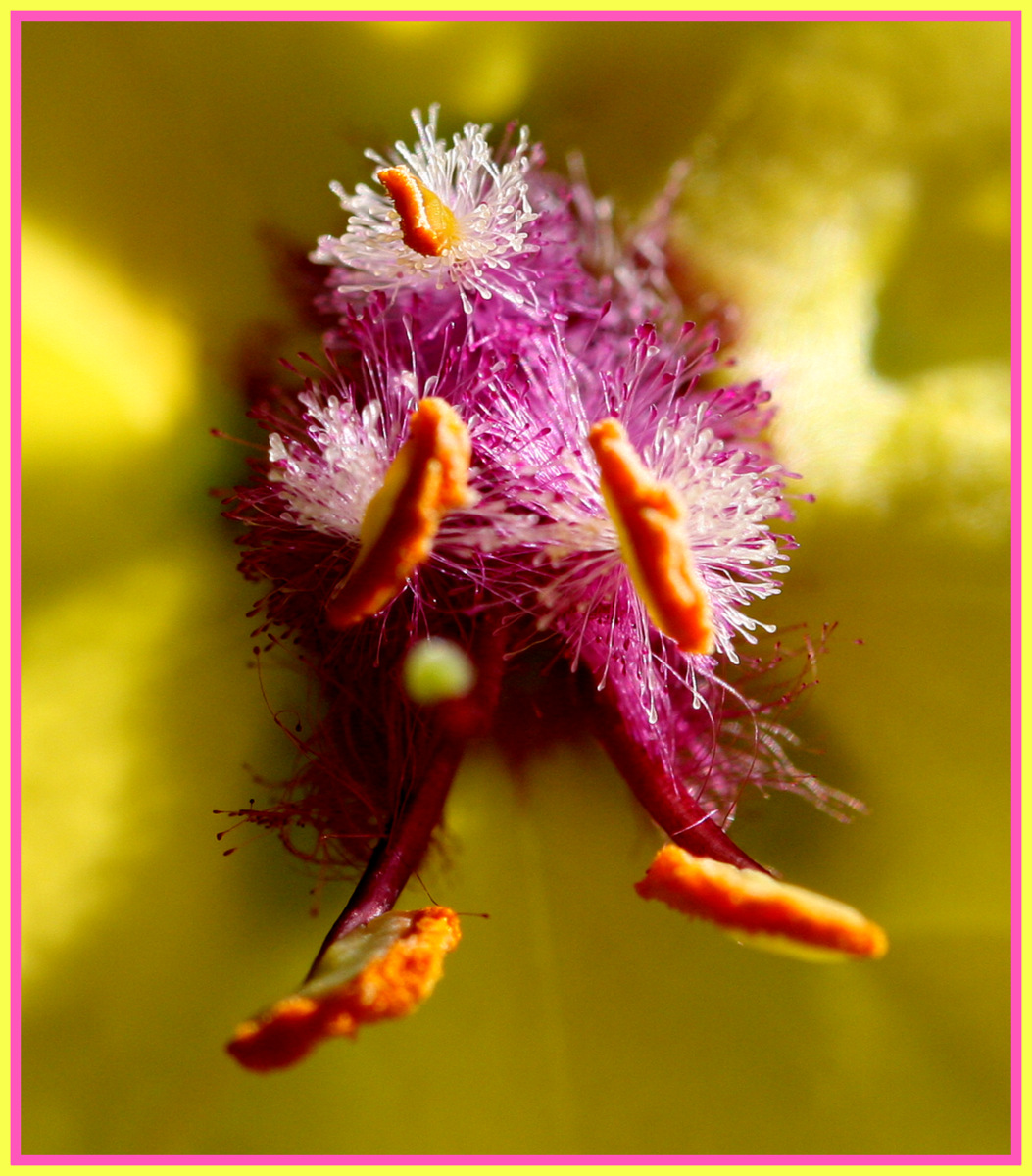
  • Its fuzzy filaments resemble moth antennae. Hence the name.


Look closely at the five yellow petals. They are united, or fused at their base, and nearly radially symmetrical.


(Click on any photo to enlarge)

Five orange anthers with violet/magenta hairs on the filaments. Some say it's "violet-bearded".


Well, now you've seen our first candidate. Using this system, you get to assign the party to the candidate. How will you vote? Weed or Wildflower? (Use comment section below)


Moth Mullein - (Verbascum blattaria)

Photo Location: Townsend Park, (Townsend Park) Kent County, Michigan