Showing posts with label vines. Show all posts

Monday, September 25, 2017

Carried


Grazing the inner landscape for ideas,
I am carried into a wider existence,
a greater awareness,
carried by the current of creativity.


As the growing vine
reaches out with tendrils,
seeking an elevated position,
carried closer to the light,

I carry this invitation to you;
to enter the oportunities
of artistic expression,
as you expand your love of the land.


© 2017 Richard Havenga


Thursday, October 6, 2016

Monday, May 19, 2014

Spring Pastel


Driving slowly down the road,
I had to stop, and back up,
to admire this spring pastel,
framed with pale green leaves
from wild grape vines.

Slowly walking closer, 
the simple became elegant.
While framing the picture,
I listened to the maple samaras
fluttering like wind chimes. 

What colors would the artist select
to recreate of this moment?
Working at her easel, would she
feel it deeper, sense more fully,
experience greater contentment than me?

I try to remain attentive,

looking for opportunities
to accept with admiration
these small gifts
which resemble prayers.

Small gifts, small prayers,
like these wind chimes
alive with praise
within this
spring pastel. 
©  2014  Richard Havenga


Photo Location:  Gavin Lake - Parnell,  Michigan


Sunday, November 18, 2012

Bittersweet

Bittersweet


I always look forward to this time of year, very late fall, when the brilliant fruit of the Bittersweet begins its show-off season.


During the summer months this mass of green leaves goes mostly unnoticed, as just another wall of vegetation. These leaves, now turning yellow, are alternate, smooth on both sides, and about 2" X 4" (5-10cm).

Earlier still, (May - June) you may overlook the small, greenish flowers. That's to be expected, since all my Botany books call them "inconspicuous". The tiny flowers (not shown) are only 1/8" (4mm) wide, with 4-5 petals, growing in tight clusters.


Later, about mid-October (in southern Michigan), the leaves begin to drop. The fruit is maturing. If you are outdoors then, and if you are looking, you are likely find these pale orange capsules,  1/2" diameter (4mm) , still closed.


Do you think they resemble miniature pumpkins?


Little gourds?


This is a good overall view of leaves, vines, petioles, and some fruiting capsules beginning to open.


Here, more capsules have dried enough to split open, curl back, and reveal the glossy,
berry-like interior; actually fleshy seeds, in clusters at the stem tips.

As the thin outer shell opens, it usually splits into three parts, and folds back to expose the showy, reddish-orange center. Now is when they call it a bi-colored fruit.


In this view you can see a portion of a small, hard seed, barely exposed from within the deep orange flesh. Also notice how the shell and the interior fruit is divided into thirds, most of the time.


Other names for this plant: American Bittersweet, Climbing Bittersweet, False Bittersweet, Waxwork,, and Staff Tree. The Burning Bush is a close relative. If you have one in your landscape, you may see the resemblance of its berries to Bittersweet.


It is moderately shade tolerant, but prefers the full sun, and will climb an average of 20 to 40 feet (7-13m) to get it. Up to 56 feet (17m) maximum. They may also sprawl and drape over the ground or low shrubbery, or even use its old self for support.


This one near Pickerel Lake (see: Pickerel Lake Loop) climbed 18 - 20 feet (6-7m) up this Red Oak.
 
Bittersweet grows in a variety of habitats -- in rich soils along roadsides, thickets, riverbanks, and woods. It seems to prefer edges; you will rarely find it deep in the forest.


Here's a nice swirling, twirling  batch hanging out over the Grand River, east of Ada, Michigan. This vine was climbing another vine; Wild Grape. Do I see an almost heart-shape in there?


Range: From Quebec to North Carolina, west to Manitoba, Kansas and New Mexico. In the southern parts of its range, it is found at higher elevations.


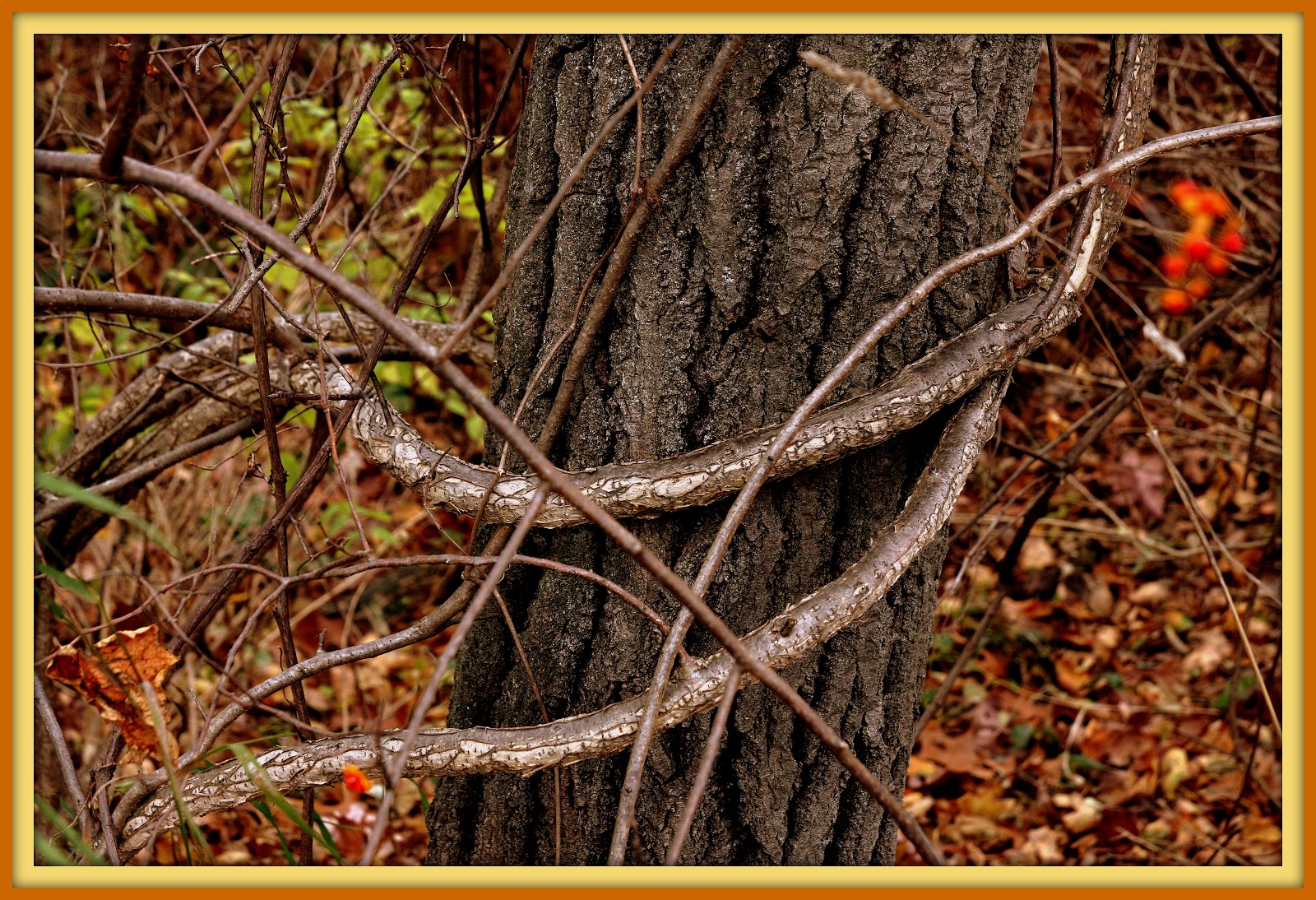
Unlike many climbing vines, (see my posts: Virginia Creeper, and Virgin's Bower) Bittersweet has no tendrils to cling with. Instead, it spirals tightly around host stems, mainly saplings, and tree trunks. Its grasp is so snug, that it may strangle its own tree or shrub support.


It is common to see two, three, or more vines climbing up one support. It seems the higher up the trunk they go, the tighter they cling.


Bittersweet fruits are mainly dispersed by birds, through their droppings, but it is not a favorite food of wildlife. Seeds are occasionally eaten by game birds, songbirds, and squirrels. The primary consumer of seeds and buds is probably the Ruffed Grouse.


Because of the beauty and ornamental appearance of this vine, and the durability of its fruits, it was once widely collected for decorations.


A generation of stern warnings against cutting it has perhaps saved it. In my personal observations over the past 30 years; not only is it surviving, it is absolutely thriving in our area.

I remember my Grandfather collecting it. I remember my Father collecting it. I've been collecting it for years to give away to friends and family to use for decoration on Thanksgiving Day.


I want to give you these two posters of Bittersweet. Please share them with family and friends.


Have a happy Thanksgiving Day. We have so much to be thankful for.


(Click on photos to enlarge)

Photo Locations:

Cascade Township, (Cascade Township) Michigan

Grand River,  (Grand River)  Ada Township , Michigan

Pickerel Lake Park,   (Pickerel Lake Park)  &  Cannonsburg,  (Cannonsburg)  Michigan


Resources:

Forest and Thicket - John Eastman (Eastman)

National Audubon Society Field Guide to Wildflowers (Eastern Region) c 2011 (Audubon)

Fieldbook of Natural History - E. Laurence Palmer c 1949 (Palmer)

Thursday, November 15, 2012

Virgin's Bower

Virgin's Bower

The annual leaf drop (Leaf Drop) is over. Branches are mostly bare. We are left with a view of Autumn's stripped trees show.

Visibility into the woods has dramatically improved. With this new vision, we can see new things exposed. Details that were once hidden in the dense curtain of summer's green foliage, now catch our eye.


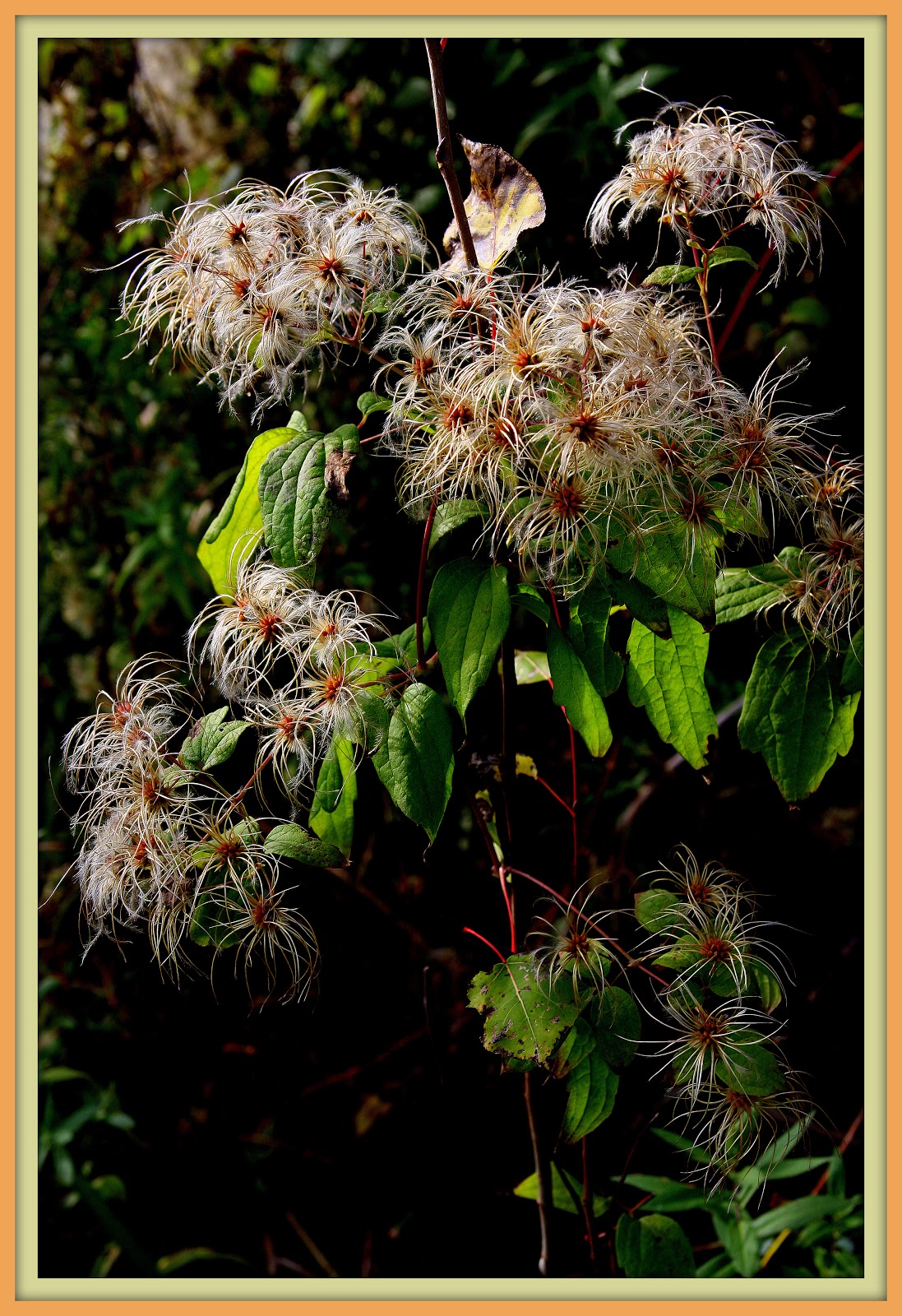
A perfect example is Virgin's Bower, with its silvery, silken plumes.


You may have noticed these twisted, spiralling, patches of feathery fluff.


Virgin's Bower is a slender, climbing vine that sprawls over shrubs and low trees, walls and fences. It often occurs covering riverbanks or streambanks with an intertwining mass of vines and stems.


The photo above was photographed hanging over the Provo River in the Provo Canyon, in Utah.


The next several photographs are taken in Michigan.


 These are found growing in moist places, lowlands, and damp thickets.


"Attractively conspicuous" is a good way to describe this plant.


Other names from older days:  Devil's Hair, Wild Hops, and Devil's Darning Needle.

 Thoreau called it Woodbine...


and "Old Man's Beard"


Vines average six to twelve feet (2-4 meters) long.


This one stretches 15 feet (5 meters) as it climbs up the branches of this young Poplar sapling.


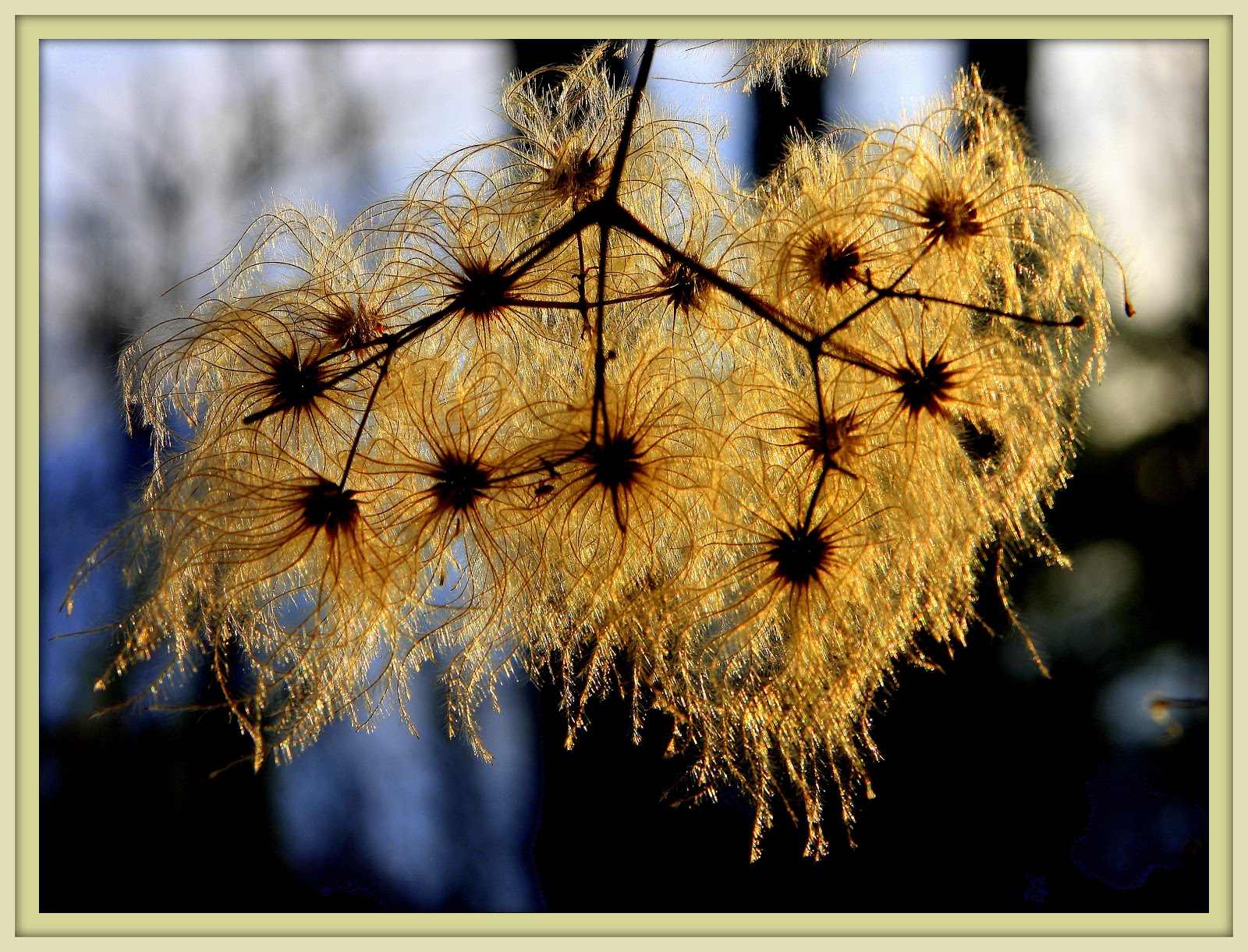
It is the pistils that develop into these slender structures with long, curved, feathery tips. 


The seed, eventually, is carried by these plume-like, curved tails.


Here, the seeds begin to disperse; a process that continues for several weeks.


The Virgin's Bower native to the Eastern U.S. (Clematis virginiana)  has small, creamy white flowers (not shown) in clusters growing from the leaf axils.


This yellow-flowered variety I discovered in the West.


It's probably a species that has escaped into the wild, but is still in the same Genus (Clematis sp.)


Elongated pistil structures just beginning to sprout silvery hairs, and blowing in a stiff breeze.


Virgin's Bower hanging tough in mid November in southwest Michigan.

When you take your walk, or run, outdoors this week, maybe you will see the exquisite, the beautiful

Virgin's Bower.


Virgin's Bower  (Clematis virginiana)

(Click on photos to enlarge)


Photo Locations: 

Grand River Drive,  Ada Township Park,  (Ada Township Park)  Ada,  Michigan

Provo River,  Provo Canyon,  (Provo Canyon)  Utah


Tuesday, October 9, 2012

Virginia Creeper


It's not only trees showing off their rich colors this season. Take a look at this fine vine named Virginia Creeper :


It accents nicely this red building on the Grand River (Grand River) near Ada, Michigan.

Now you know what to call these climbing columns of crimson the next time you see them.


Of course they're rooted in the ground, and begin to climb whatever is available; sometimes surrounding the entire tree trunk.


These vines are thriving high in the branches of an American Black Walnut tree. A handful of yellow leaves are still hanging on. Walnut is one of the first trees to shed its leaves in the fall.


If the support is short, Virginia will creep to the top, crawl along the rails, or use itself for additional growth. Sometimes there's nowhere left to go but down...


... and Virginia is quite satisfied just hanging and dangling in the breeze, because it loves the sun, but can tolerate the shade...


Virginia Creeper will occasionally attempt to climb an evergreen, ...


... but notice how it prefers to stay out on the perimeter for better access to sunlight.


This Fir looks pre-decorated for Christmas.

Please do not confuse Virginia Creeper with Poison Ivy.


This photo is from a previous post. See the entry for May 7, 2012 : "Father Nature Quiz" (Quiz) .

 Left = Virginia Creeper; Right = Poison Ivy; with the bad reputation.

Poison Ivy - always, always, always 3 leaflets; not toothed, or slightly toothed; that is, just a few notches.

Virginia Creeper - almost always 5 leaflets; rarely 3 or 7, coarsely toothed; that is, several teeth along the leaf margin.


Another view of Poison Ivy, just to confirm you will recognize it on your next outing.


Virginia Creeper's Genus name, Parthenocissus, is from the Greek, meaning: "virgin ivy".

The species name, quinquefolia, means five-part leaf.

It's related to the Wild Grape, and has a very similar growth pattern.

Other names for Virginia Creeper: False Grape, American Ivy, Five-leaved Ivy, and in the olden days, Woodbine.

The greenish, clustered, inconspicuous flowers are insect-pollinated.

I think the coolest thing about this vine is how it climbs. The tender tendrils reach out, seeking a supportive surface.


When they touch the support, the tendril tips secrete a glue-like substance, and small discs form, which cling to the surface. These clasping little pads are persistent, and remain "glued" long after the vine dies.


The vine on the left is alive. The vine on the right has died; yet the pads persist, clinging to the post.


Over time, these discs can erode and crumble a smooth masonry surface.


This shot reminds me of a lizard's toes climbing up the post. Or a Tree Frog's toes; see previous post "Blog the Tree Frog" (Tree Frog) July 21, 2012.

In addition to the beautiful red leaves, their fruits are also prominent this time of year. They develop into dark blue (1/4" - 3/8" , 6 - 9 mm, diameter ) berries when mature; growing in loose, red-stalked clusters.


This creeper is growing along a Wild Grape vine, both competing for sunlight.


Here's a good-looking snack for several birds and a few mammals.


 The berries are high in fat content, and often remain on the plant into the winter.

Many bird species feed on these berries. They are a favorite of many woodpeckers, including: Downy, Hairy, Red-bellied, Pileated, Northern Flicker, and Yellow-bellied Sapsuckers. Other frequent feeders: Great Crested Flycatchers, Eastern Bluebirds, Wood Thrush, Swainson's Thrush, American Robin, Brown Thrasher, Red-eyed Vireo, and Fox Sparrow. Game birds that consume these berries are Wild Turkeys, Pheasants, and Grouse.

FYI : Fermented fruits on the vine occasionally intoxicate birds.

Mammal consumers: Red Fox, Striped Skunk, and Eastern Chipmunk. White-tailed Deer browse the twigs and foliage.

NOTE : Virginia Creeper berries are NOT for human consumption! They can be fatal if eaten in large quantities.


Well, everything I know about this fine vine I have shared with you. I am a lifelong student; and if you can teach me more, at the age of sixty-four, I am still thirsty for knowledge. I hope you've enjoyed meeting "Virginia Creeper". These climbing columns of crimson will only last a short time before they age with the shortening daylight, succumb to the effects of frost, and are stripped away by the winds.


I encourage you to get outside, breathe in this fine Autumn air, take a walk on your favorite trail, and look longer and deeper for this magnificent creeper. When you find her, tell Virginia that "Father Nature" sent you. She may remember me.


Resources:

Forest and Thicket - Trees, Shrubs and Wildflowers of Eastern North America, John Eastman  c  1992 (Eastman)

How to Know the Wild Fruits, Maude Gridley Peterson  c  1973 (Peterson)

Hal Borland's Book of Days,  Hal Borland  c  1976 (Borland)

Fieldbook of Natural History, E. Laurence Palmer  c  1949 (Palmer)


Photo Locations:

Home Woods, Rockford, (Rockford) Michigan

Grand River (Grand River) @ Ada, (Ada) Michigan
Cannonsburg, (Cannonsburg) Michigan

Elk Rapids, (Elk Rapids) Michigan

Reeds Lake Trail (Trail) @ East Grand Rapids, (EGR) Michigan