Showing posts with label Dendrology. Show all posts

Saturday, October 31, 2015

WITCH !

Can you believe this? Flowering in late October, and into November?


I'd like to introduce you to the WITCH ...


Witch Hazel.

Hazel has the distinction of being Michigan's only woody plant which blossoms in late autumn, sometimes after the first snowfall. It is the last flowering plant that Father Nature knows of.


Witch Hazel is a common shrub, or small tree, growing in the understory of other hardwood, deciduous trees. Typically 12 to 20 feet (4 - 7 m.) tall.


Its growth form displays several arching or crooked stems that together produce an irregular, open crown. 


Each clump is one plant. They are slow growing, and moderately shade tolerant.


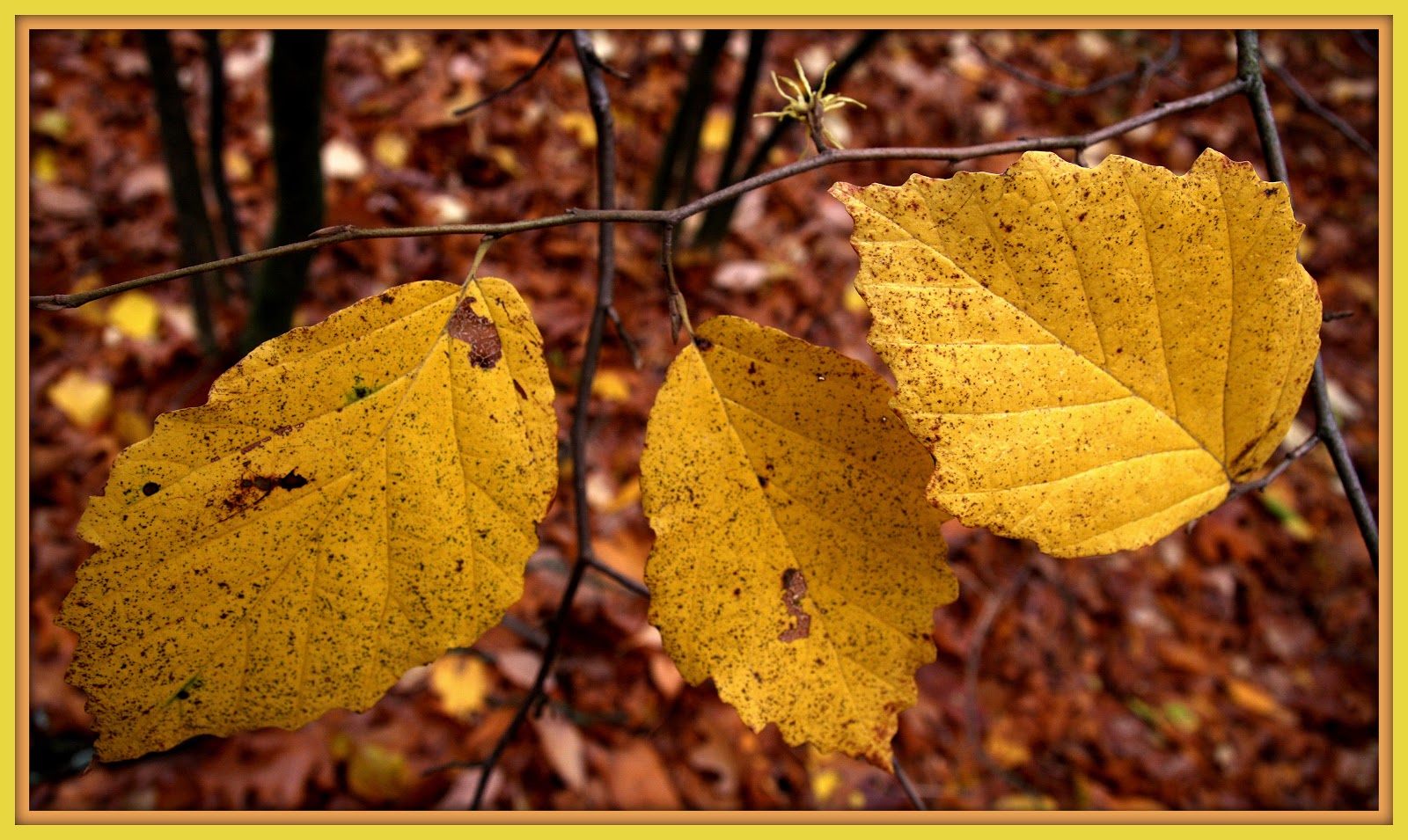
The leaves are generally oval, with uneven bases, 4 - 6" (10-15 cm) long, and attached to the slender twigs by short petioles. And, as you can see, very conspicuously veined.

The wavy-edged margin is slightly toothed or shallow-toothed. (For the serious Botanists out there: a sinuate-dentated margin) You could also call it scalloped.


The tawny, lateral buds are barely noticeable, being naked, except for two small scales. Terminal buds, at the end of twigs, are slightly larger, and flattened.


Flowers are usually in clusters of three; sometimes four or five. See the four-lobed calyx, and four petals, shaped like tiny, yellow ribbons, each a half-inch (1.5 cm) long.


In the bud, these petals are rolled inward in a tight, close spiral; like a watch spring.


Coiled tightly into a solid, little ball, only a few millimeters in diameter.


After the leaves have fallen, these yellow, starry flowers are more conspicuous, and bring light and warmth to the woods in late Fall.


(Starting to split open)

The nuts, or capsules, require a full year to mature. They are about 1/2" (1.5 cm) long, and covered in a velvety outer husk. These shown above, are just slightly  larger than life size.

(Split open, seeds scattered)


The inner shell is extremely hard and contains two, brown-black seeds. They are polished and smooth. I was unable to find any of these tiny, shiny seeds. Perhaps your kids can crawl around on the forest floor and come up with some. Better yet, prune a few twigs containing these capsules, and take them indoors. When they dry out, if they're mature, they will blast out the seed with amazing force. If you're lucky, you will hear them ricocheting across the counter, or bouncing onto the kitchen floor. In the wild, they are expelled with power; shot out 10 - 20 feet (3-7 m) from the parent plant.

Father Nature did this years ago. If you need some minor entertainment, it works. Maybe the seeds will pop when the kids are quietly doing their homework, like it happened for his kids, back in the day.


Lore:


Witch Hazel oil, distilled mainly from the twigs, is one of those all-purpose healing remedies legitimized by long tradition if not by medical science. It is still an over-the-counter item in drugstores.

Another ancient tradition is the use of forked Witch Hazel branches as "divining rods" for "water witching". People who believed in its powers swore on its ability to point to underground water, coal, tin, and copper lodes.


(Click on any photo to enlarge)

Slender twigs hold clustered blossoms.


Unfolding their bent and wrinkled, strap-like petals...


... into fine, narrow bands.


"In the dusky, somber woodland, thwarting vistas dull and cold,

Thrown in vivid constellations, gleam the hazel stars of gold,

Gracious gift of wealth untold." Anna Botsford Comstock  (1854 - 1930)


Resources:

Handbook of Nature Study - Anna Botsford Comstock  (Comstock)
Cornell University Press  c 1911, 1939

Michigan Trees - Charles Herbert Otis  (Otis)
 University of Michigan Press  c 1931, 1965

Textbook of Dendrology - William Harlow, & Ellwood S. Harrar  (Dendrology)
McGraw-Hill Co.  c 1937, 1958

The Book of Forest and Thicket - John Eastman  (Eastman)
Stackpole Books  c 1992


Photo Locations:

Home Woods

Egypt Valley State Game Area,  (Egypt Valley)  Kent County,  Michigan (Michigan)


Friday, July 11, 2014

one hundred thousand


An early sun
climbs into July,
warming the air
among these trees.


One
hundred
thousand
leaf blades
on this towering
Cottonwood
begin to quiver
in the fresh breath
of morning.


Then the breeze
holds its breath.

The petioles pause;
firm in their flatness,
motionless.


Now the wind returns
to repeat the wavering,
to resume
the green flags fluttering.


The curved teeth
along the margins
biting the wind.

One
hundred
thousand
leaves
dancing
to the sound 
of their own 
music.
©  2014 Richard Havenga


Photo Locations:

Grattan Township, Cascade Township - Kent County,  Michigan  (Michigan) 


Eastern Cottonwood - Populus deltoides


Friday, June 14, 2013

Mittens & Moccasins


Mittens


Moccasins


Redbud - Cercis canadensis
 
(Click on Photos to enlarge)
 
Photo Location: Home Woods


Thursday, October 18, 2012

grandifolia


grandifolia


Why do I like the American Beech so much?
Why is this my all-time favorite deciduous tree?


Is it the graceful
(oblong-ovate, accuminate)
shape of the leaf;
arching out from its base
to broaden, then taper gradually
to the narrow tip of its apex?

Is it the slender, delicate twigs; 
zig-zagging slightly,
and bearing tightly wrapped,
perfectly conical,
sharp-as-a-pencil-point buds,
colored a rich, glossy brown?

Is it the coarsely
serrated margin
of the leaf edge,
with a vein terminating
in each  of the short, sharp,
excellent and even teeth?

Is it the fine lines
of green persisting
in the parallel and perfectly
pinnate veins
streaking through
the deep yellow leaf?


All of the above.

American Beech... above all.

Fagus grandifolia... absolutely grand foliage.


To witness the birth of these leaves, see previous post:  "Holding Life"

 (Holding Life)  (June 1, 2012)


Photo Location:  Home Woods


Thursday, May 10, 2012

Black Cherry

My love for trees and appreciation of their intricate details was planted in me by Dr. Agnes Lisle. At age 19, I could not have realized that what she taught us would stick; this long, this deep. About 16 young men at Grand Rapids Junior College (now GRCC) took Dr. Lisle's Biology 103 as sophomores: DENDROLOGY. Dendro - tree, ology - the study of.

The course was intense. She was demanding. Expectations were high. It stuck. Because here I am 45 years later sharing Dendrology with you, around the U.S., around the world. If she could see me now! Maybe she'd change my B+ to an A-. But I'd have to retake the Final Lab Exam: 100 Deciduous trees, 25 Conifers; including common names and scientific names. Often only a dead twig to examine for identification. It was tough!

Our professor must be in her low 100s now, if she's alive, aging gracefully like a tall White Pine. If not, I still send this message: "Dr. Lisle: Thank you for your high expectations."

This bookmark is for you...


Last weekend, high in a Black Cherry tree, my wife and I were watching a Yellow-throated Vireo, near McCarthy Lake. He blended nicely with the emerging leaves. Through the binoculars, I saw tens of thousands of tight, white buds.


This elongated arrangement of flowers is called a raceme, or spike. It's 4-5 inches long. Here is a nice clump of these drooping clusters.

Many flowers in various stages of development.

This next shot shows the leaves, not yet full-size. Notice their alternate arrangement on the twigs; not opposite, like you saw in "The Understory of Dogwoods" piece in April. The margin (the outer edge of the leaf), is finely serrate, with those fine teeth incurved. (Click on photo to enlarge)


If you look closely at the petiole (the stem of the leaf) you will see two small dots. These are special glands, unique to the Black Cherry leaf.


A bit closer now, count the current and future flowers... how many? ...


... times how many spikes on a large tree? That's a huge number of pollination visits by insects.


The Black Cherry is the largest and most common of the wild fruit trees. This medium-sized tree grows 40' - 60' high, and is 8" - 36" in diameter. They are seldom found in pure stands, but mix generally with other deciduous trees such as oaks, hickories, maples, ashes and elms. Its leaves are a food source for over 200 species of moth and butterfly caterpillars.


After being pollinated by insects, they produce a small, globular drupe (a fleshy or pulpy fruit with a hard, stony pit inside). Similar to the delicious Sweet Cherries made Nationally famous by the Traverse City Cherry Festival in NW lower Michigan.


 Remind me to show you these drupes in September. They are much, much smaller; only 1/3" to 1/2" diameter, purple-black with juicy flesh; slightly bitter, but edible.

I highly recommend the sweetness in the Traverse City cherries. The festival dates for this year are:
July 7-14, 2012.


About 70 bird species feed on the black cherries. Ruffed Grouse and Ring-necked Pheasants eat the seeds that have fallen to the ground. Cedar Waxwings, Grosbeaks, Thrushes, and others consume them in the tree. Sometimes they become intoxicated on the over-ripe, fermented drupes... the stupes!

The little cherry pits are regurgitated or dispersed in birds' droppings. A bird's digestive process actually increases the chances for germination. Black Bears and Raccoons will climb for the fruits. Other mammals that like the cherries include: Red Fox, Red, Gray, and Fox Squirrels, Cottontail Rabbits, and White-footed Mice. Eastern Chipmunks are known to store the seeds (pits) for occasional winter meals when they might wake from hibernation.

This next photo contains a nice spike (raceme).


On the surface of the leaf, is a strange, finger-like growth. This little red structure is caused by a mite. It's called a wild cherry "pouch gall". I've seen leaves holding over 20 of these, growing like stalagmites from its surface. A great way to remember how it was made.

Come in closer now. A few flowers are open, a few still closed...

... as they mature gradually from base to tip of the raceme. This encourages return trips for pollinating insects. Observe five white petals, 15-20 stamens (the male part: the filament, which is the stalk,  supports the anther, which produces the pollen). The stigma (the female part) is thick and club-shaped.


Another look at more mature flowers, showing nice anthers atop the filaments.

Now, let's back out to see the bark of the Black Cherry tree. Here are three, 14" diameter trunks, displaying thick, irregular plates.


And back in a bit closer, about three feet away. We see what Naturalists call the "burnt potato chip" look.


Father Nature can't leave you here staring at these gray tree trunks (the neighbors will think you're strange).
So here's a more attractive image to burn into your memory, as you go out to discover them yourself, and hopefully grow your own love for trees.


Thursday, May 3, 2012

Tamaracks

The Tamarack stands pretty low on the popularity list of Conifers, but not for me; and I'm out to change your mind.  The Pines and Spruces are well-known. Then the Hemlocks and Firs, followed by the Cedars and Junipers. Think of Tamaracks as the undrafted free agents. They don't attract a lot of attention, but they're in my top five list of favorite trees.


You must be intentional if you want to observe a Tamarack up close. The terms Tamarack swamp, and Tamarack bog may not appeal to the average person, but you are above average, always eager to learn. So put on your knee boots and take a Walk With Father Nature.


You can distinguish Tamarack from all other conifers by these unique characteristics:

Numerous, short, soft, light blue-green needles.


(Hardly a needle, it is so soft and pliable) From a distance, they appear "feathery".

"Warty" twigs (looks nicer than it sounds).


Short cones ( 1/2" - 3/4" long).


They shed all their needles in the fall. I have shots of those golden needles, just before falling, but I will save them for the fall. Guess you'll have to come back.

A Deciduous Evergreen is an oxymoron.
A Deciduous Conifer sounds odd, but is accurate for the Tamarack.
Conifer simply means cone-bearing.

HABITAT:

They require open sunlight, forming a pyramidal crown. The lower section is broader, more open, with irregular horizontal branches.


Tamaracks grow rapidly for 40 - 50 years, then it slows considerably, reaching possibly 150 years old.
Height = 40' - 50', 75' max. Its root system is shallow and wide-spread in the wet ground.

LEAVES:

Needles are scattered singly on new shoots, but clustered (in bundles of 15-35) on short, lateral branches. They sprout from what looks like a miniature, woody stump, with concentric rings.


FLOWERS (Cones):

Unisexual; on the same tree. Female cones start out with rose-red scales; appearing on 2-4 year old branches.


They ripen in the fall and shed their seeds.


The northernmost Tamaracks reproduce by new shoots rising from buried branches.


OTHER:

Infestations of Larch Sawfly attract several bird species to the Tamarack. Red Crossbills extract seeds from the cones, while species of grouse consume the leaves (needles) and buds. Mice, voles and shrews stash or eat seeds fallen to the ground. Snowshoe Hares and Porcupines feed on the bark.


References:

The Book of Swamp and Bog
(Trees, Shrubs, and Wildflowers of Eastern Freshwater Wetlands)
John Eastman
Illustrated by Amelia Hansen
c 1995 Stackpole Books

Michigan Trees
Charles Herbert Otis
University of Michigan Press
c 1931, 1965